 The past week has served up a fascinating lesson in how markets actually work versus what the headlines would have you believe. The past week has served up a fascinating lesson in how markets actually work versus what the headlines would have you believe.
Let's start with the UK, where breathless reports of political turmoil supposedly triggering a rush out of UK assets turned out to be largely mythical.
Yes, UK economic growth came in marginally lower than expected for 2025. The UK stock markets went up anyway in a textbook example of "buy on bad news," particularly when assets are as cheap as UK equities currently.
No doubt much to the chagrin of headline writers, the main UK stock market indices were up 0.5% over the week, with smaller companies up slightly more at 0.8%
Not huge gains, but better than the losses in the US, Germany and Spain.
When sentiment is already in the gutter and expectations are low, it doesn't take much to surprise on the upside. The UK market remains one of the cheapest developed markets globally, and smart money knows it.
Across the pond, Trump reversed legislation for climate change action, hurtling the US even closer to the Dark Ages. To paraphrase him, this is probably the greatest single act of stupidity in the history of the world… well… since his Tariff Tantrum last April… and that assumes going to war with Denmark was a joke. This sort of insanity doesn’t help US stock markets. As a UK-based investor you are losing money in US equities year to date, with the UK being top, up 5%, and only surpassed by Japan. On which note…
Japanese voters handed Prime Minister Sanae Takaichi a landslide re-election victory on 8th February—the Liberal Democratic Party won 316 seats, a historic supermajority and the biggest electoral victory since the party's founding in 1955. The catch is that her manifesto was remarkably light on detail. Takaichi campaigned on vague promises of "responsible but aggressive" fiscal policy and security reforms, without spelling out the specifics.
Can they afford any of these? Without clarity on her actual plans, it will be left to their bond market to judge, which might be uncomfortable for markets.
Speaking of policy missteps, the cryptocurrency market gave a master class in regulatory mis-timing. Bitcoin has lost its "Trump bump" despite the administration's crypto-friendly promises. The real irony is the UK's FCA authorisation of retail crypto ETFs in October 2025, just as Bitcoin was peaking. About £3 billion languishes in these ETFs, and are down about 40%-50%.
Something similar occurred in 1999/2000. Watching Channel 4 news I was amazed to see a senior player in the then UK regulator (the FSA) telling the world that the best option for their pension savings was the new Stakeholder Pension? Why? They invested into index trackers, and these were cheap. That was it. No sense that financial markets were midst the largest investment bubble for a couple of centuries. No word on the risks. In the next three years the UK market fell just short of 50%
The real earthquake this week came from AI—specifically Anthropic's release of new AI-powered tools from Claude. These can now automate work across a wide range of industries - legal, sales, marketing, and data analysis. The market's response was swift and brutal, with a range of impacted companies suffering double-digit percentage losses.
According to the Financial Times, evidence has been emerging over the last six months of an AI breakthrough in actual takeup and deployment, moving beyond the experimentation phase. Personally I find it an extraordinarily useful tool.
But those close to the coal face aren’t all happy. Mrinank Sharma, an Oxford graduate who led Anthropic's AI safeguards research team, just resigned with a cryptic warning that "the world is in peril". He's retiring from the AI industry to write poetry. Yes, it’s true. The man tasked with keeping AI safe has concluded that the situation is so dire, his best contribution is verse.
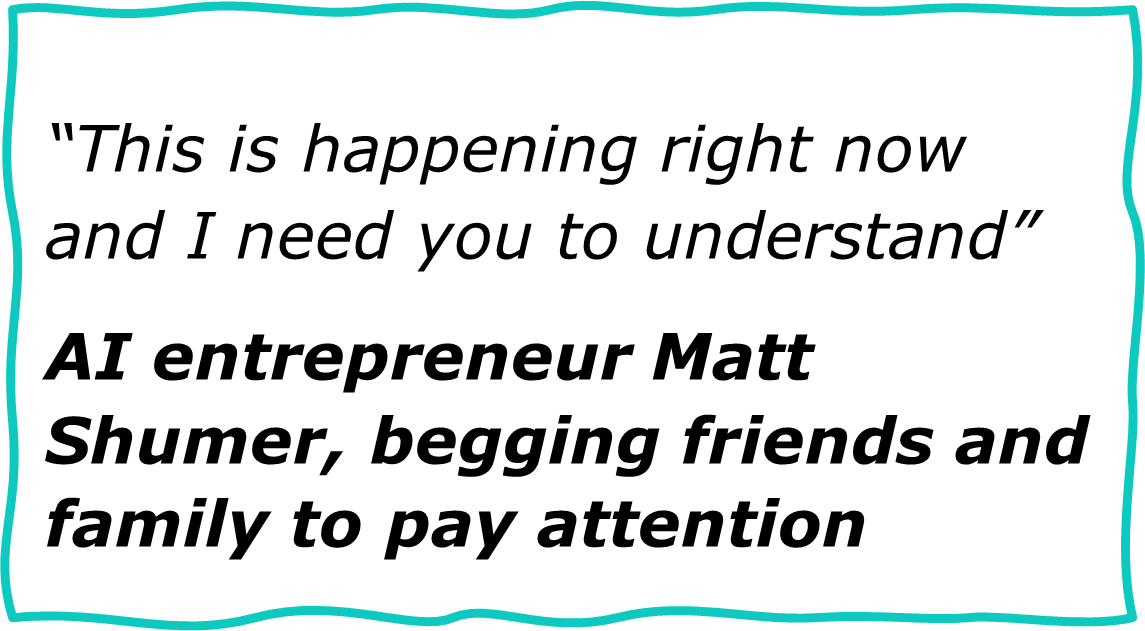
At the same time, Matt Shumer, co-founder of a New York based AI business, published a viral blog post comparing AI's current moment to the early days of COVID, when no one really “got it”. It has been viewed over 60 million times. It's elevating and deeply worrying in equal measure. Shumer argues that AI can now do his technical work better than he can, and predicts that "if your job happens on a screen, AI is coming for significant parts of it". His timeline? One to five years, possibly less.
In a nutshell, he is arguing that AI is advancing far faster than public perception, with disruptions likely to happen sooner than expected. This feels right to me – though I put it no more strongly as I am a simple non-techie who remembers telex machines.
But don’t confuse this potential with success for all the big companies throwing hundreds of billions into AI. Few will succeed. The greatest rewards will fall to the non-tech companies who adopt, and adapt to, AI fastest.
Finally, gold and silver. After hitting record highs both metals suffered large sell-offs. Gold dropped 21% at worst, while silver collapsed 30% in its worst day since 1980.
They've stabilized somewhat this week, with gold back above $5,000 and silver around $80-85. Is this a dead cat bounce? No one knows for sure. But punters piling into silver is a fair signal that the worst is not yet behind us, as the mania is still simmering.
We're living through a peculiar moment. UK assets rising on bad news because they're cheap. Japan voting for uncertainty wrapped in a landslide. Crypto crashing after regulatory approval. AI simultaneously creating and destroying trillions in value. Precious metals whipsawing like penny shares.
The common thread connecting all of this is that financial markets are repricing faster than consensus can keep up. Whether you're bullish or bearish, complacency is not an option.
The investor need for trusted input has never been greater. So it was sad this week to see more commoditisation of the advice industry with NatWest announcing a takeover of Evelyn Partners.
This is an increasingly complex environment. If it concerns you, consider delegating and using a professional. Obviously I will recommend Dennehy Wealth, but we also suggest shopping around – perhaps use Dennehy Wealth as your benchmark. We will even provide the essential questions you must ask any other firm with whom you are discussing your options.
If you haven’t done so already, have a read of the latest TopFunds Guide. I would love your feedback.
|