I had the pleasure of being at Wimbledon this week. It reminded me that in tennis, and life and investing, it is important to avoid unforced errors, often resulting from bizarre impulsive behaviour.
If you want to be a Wimbledon winner you have to minimise unforced errors. Whether you want to be at your best as a tennis player or investor, or indeed your own area of lifetime expertise, you must minimise such moments of impulsiveness. High achievers in their field need skill, discipline, and even luck – never underestimate the need for a little luck, though the precise mix varies between professions and sports.
For example, a dentist shouldn’t need luck, but a weatherman does. A tennis player will need more discipline than a footballer, and a footballer can benefit more from luck.
One of the greatest baseball hitters of all time, Ted Williams, wrote a book called The Science Of Hitting. He identified that when people make bad decisions, they disregard what they know, ignore coaches, and become impulsive. They stop thinking clearly – process and discipline go out the window.
It is the process by which you make decisions which is key – that process is at the heart of your skill. It moves the odds of success in your favour. A good process, a proven process, increases the odds of much better outcomes.
When investing, one single unforced error can destroy your life plan built around your investments – not applying a stop-loss. Using our unique stop-loss tool ensures you are not seduced by “the market always recovers” myth of lazy and complacent wealth managers as the value of your investments collapses.
Even if you are confident about applying a stop-loss when the time comes, take advantage of the relative quiet at the moment to ensure that you are not kissing any frogs in your portfolio. Is every holding there for a clear reason? Did you write that down? Is it performing as you hoped? Perhaps you need a tidy up. If you have more than 15 funds, reduce that number – eliminate duplication and overlaps – clear out positions which are too small to make a difference.
Turning to the UK, we still don’t know if the political establishment, in this case the Labour Party, is kissing another frog. Andy Burnham has promised more State intervention, but little if anything else. The risk is that he is nothing more than a photogenic smart-casual Keir Starmer. UK financial markets are continuing to give politicians the benefit of the doubt, but this is hanging by a thread.
UK stock market indices were up over the week, between 1% and 1.5%, but lagged the rest of Europe, gaining nearly 3%. China was the laggard, drifting 2%. I will look at the US index at the end, after some more thoughts on AI.
On commodities, nothing too dramatic. Oil/energy down 2%, gold up by a similar amount.
It’s also time for this month’s “What’s Hot? What’s Not”. Amongst funds, healthcare and biotech had a stormer, with widespread double-digit gains, while gold and metals had losses on the same scale. The sector analysis reflects this plus a rare appearance from India amongst the winners (it needs a fresh look?), while smaller companies in the US and UK went in opposite directions.
I wanted to build on last week’s AI coverage by considering the parallel with the dawn of nuclear technology. I don’t have any smart questions or answers. But I do believe it is important to keep exploring what AI means for our lives in the years ahead, and not just investing.
You know that AI can help doctors, teachers, scientists, businesses, governments and us ordinary folk. It can speed up research, improve productivity and make complex services cheaper and more accessible. But the same technology can also help criminals, hostile States and terrorists. It can enable cyberattacks, deception, surveillance, fraud, autonomous weapons and social manipulation.
The debate about artificial intelligence has started to sound a lot like the debate about nuclear technology from the middle of the last century. Both are powerful technologies with two faces. Each promises huge benefits. Each also carries risks that could be catastrophic if misused or badly governed.
Nuclear technology gave the world two very different things: nuclear power and nuclear weapons. From the beginning, the same scientific breakthrough pointed in two very different directions.
In both cases, governments and society have to figure whether the benefits can be captured while the dangers are controlled.
The nuclear story began in war. The atomic bomb came before civilian nuclear power. The public first saw nuclear energy as destruction, not as electricity. In subsequent years a web of institutions and treaties were built to stop the spread of nuclear weapons while enabling peaceful nuclear technology to advance.
AI has a much messier starting point, and governments are racing to catch up.
It is not locked away in secret government laboratories. It is already embedded in everyday life. Nuclear technology has hard physical barriers, it’s expensive, visible and difficult to hide forever.
In contrast, AI has softer barriers. It needs chips, data, talent, energy and money at the frontier. Then once a powerful model exists, it can be copied, accessed, modified or misused far more easily than nuclear material. Software travels. Expertise spreads. Tools can be rented through the cloud. A bad actor does not need to build the most advanced model in the world if they can exploit one that already exist – they may not be able to cause nuclear-scale destruction, but they can cause considerable damage at scale.
For example, AI changes the economics of cyber warfare. It can help attackers find vulnerabilities, and make mediocre attackers more capable.
The danger is not one single mushroom cloud. It is a thousand smaller shocks, some criminal, some political, some economic, some military, interacting at speed.
This is why there are calls for a slow-down. Yet no major power can be confident that restraint will be reciprocated, and no major company can be confident that slowing down will be rewarded.
Of course there is also the social dimension. Nuclear weapons changed geopolitics, but they did not enter every office, school, hospital, bank, media outlet and household. AI will. Its risks are not only war and terrorism. They include job disruption, fraud, surveillance, bias, misinformation, dependency and loss of trust in what we see and hear.
Don’t despair! Nuclear history shows that governance, regulation, and co-operation is possible, and will make a huge difference. The aim is not to stop AI, but to shape it, so its considerable commercial benefits can flourish while its military and security risks are contained. That will require sustained U.S.–China cooperation. They both get that, yet history tells us that real progress is typically forced co-operation only after a painful shock. Fingers crossed.
The multi-year investment implication is undoubtedly polarised. There is considerable opportunity, but there will also be periods of notable shareholder destruction, and no one knows when or in what order. Accept uncertainty, expect the unexpected (for good and bad), keep your guard up, and stay agile.
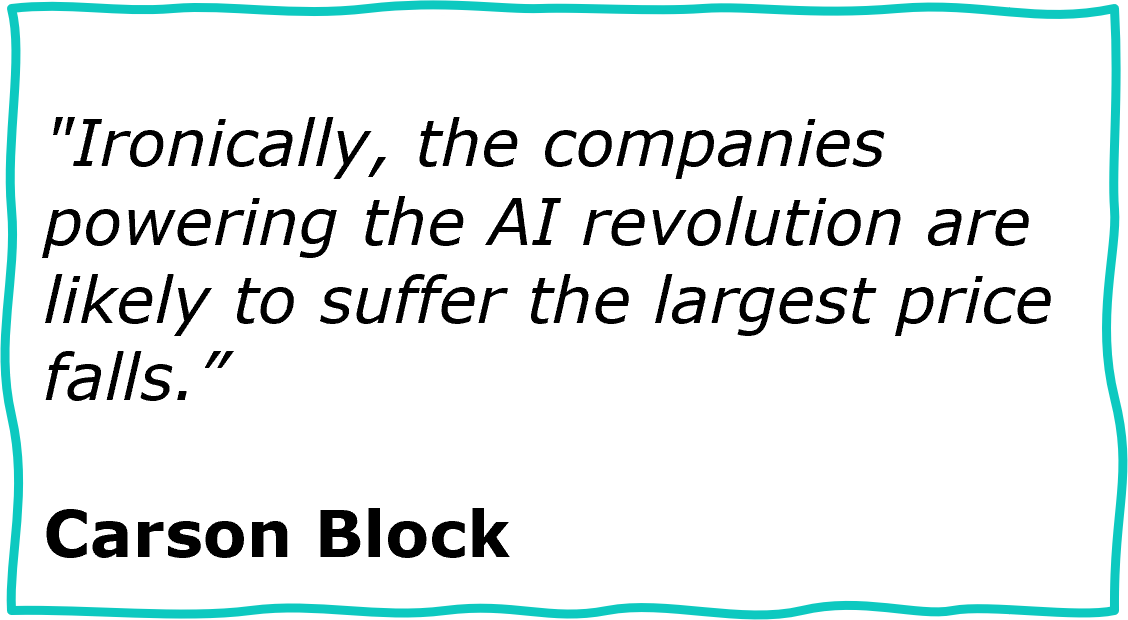
In the very short term investors have recently become more cautious about the “Mag 5” — the large technology companies committing vast sums to AI infrastructure, notably Microsoft, Amazon, Alphabet, Meta and Oracle. Much of this expenditure has flowed to semiconductor manufacturers and other suppliers of chips, networking equipment and data-centre capacity, and it is their share prices which have soared. Nonetheless, these suppliers are not insulated from the underlying economics. When the Mag 5 blink, and accept that they can’t afford to keep spending at today’s levels, there will be sharp share price falls.
Those falls have not yet occurred. Using some basic technical analysis, my working assumption is that there is another peak ahead for the pivotal S&P 500 index in the US, and that this will pan out over a few weeks, not months. If that index quickly breaks decisively below 7200 in the days just ahead the odds move in favour of a big peak already being behind us, and substantial falls.
Next week there will not be a Friday Note unless there is a major market event. Enjoy the World Cup. If you hate football, sorry.