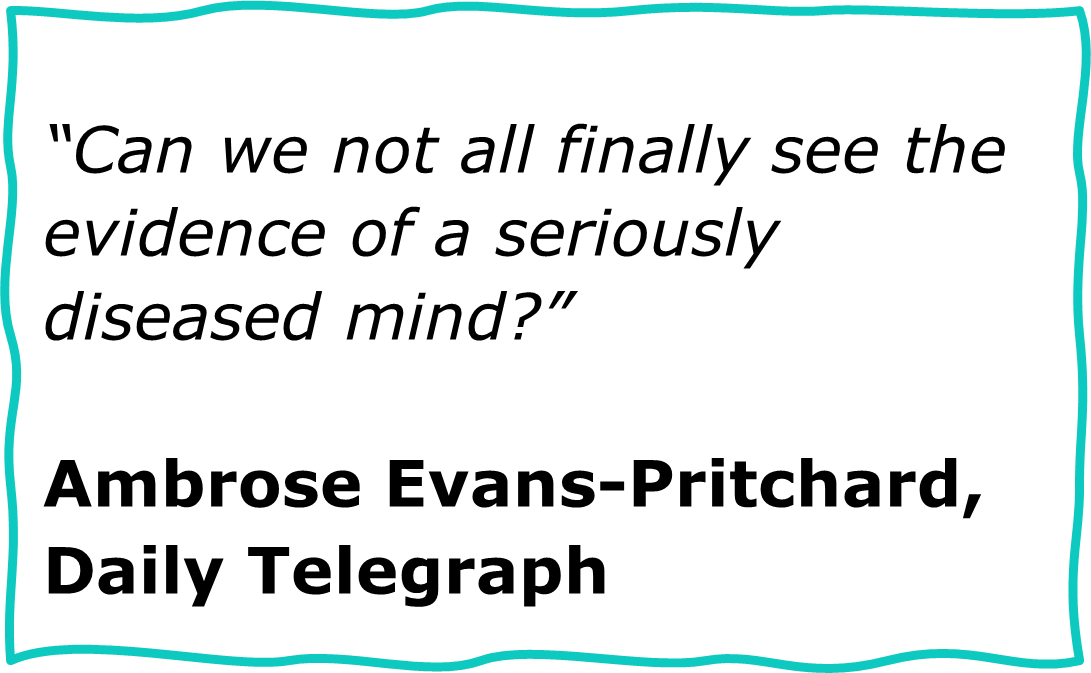
“Trump tamatigut qunutittarpoq” as Greenlanders would say: Trump always chickens out. There is increasingly open discussion of Trump suffering mental and physical issues, and his Greenland tantrum illustrated in scale how close a deranged individual can take his country to the brink. Yet we must also thank him. He has shone a bright light on opportunities around the globe, and triggered investors to think about the US bubble, and its risks, a little more objectively.
The opening weeks of 2026 have shown a fundamental disconnect between resilient US investor sentiment and growing international rejection International investors aren't merely cautious—they're actively repositioning. Sovereign wealth funds and central banks are moving capital out of US assets, a pitter-patter of exits that hasn't yet become a stampede but represents a fundamental shift in decades-long allocations.
Prominent global investment figures are openly declaring that "trust is gone". Even European policymakers, historically the most Atlanticist voices, are now speaking of "the end of the affair" — a remarkable rhetorical shift that signals institutional patience has been exhausted.
Trump’s bullying, and increasingly irrational behaviour, has transformed quiet diversification into explicit strategy, financially and politically. In December Australia’s biggest pension fund announced it was cutting exposure to the US stock market, as were British pension funds. At the time the Bank for International Settlements (BIS) warned of a “disorderly reversal” – strong language by their standards. In January, Pimco publicly announced that it mistrusted US assets, a brave announcement. And Danish pension funds are, understandably, selling US government bonds.
US government bonds are the soft underbelly of the US financial infrastructure. The US 10-year Treasury currently has a yield edging towards 4.3%. Nerves will start jangling if it heads through 4.5% and closer to 5%. More on that in coming weeks.
Although it is early days, the positive trends of 2025 have continued into 2026. The S&P 500 is a laggard (making progress of less than 1%), whereas Japan, China and the UK domestic indices, small and mid-cap, have gained 4-6%.
Bizarrely, yet also underlining how the world is fracturing, US investor confidence remains remarkably buoyant. Both institutional and retail sentiment surveys show confidence back at extremes. The S&P 500's resilience, the anticipation of deregulation, and corporate tax optimism have created a goldilocks narrative domestically that seems almost wilfully blind to mounting external rejection. Retail investors, in particular, appear captivated by the promise of "America First" economic policies translating directly to portfolio gains.
This confidence divergence is quite a tightrope for investors — US markets priced for perfection while foreign capital actively withdraws. Yet the idea of a Trump Boom is not far-fetched, as was covered previously, because Trump is desperate to regain popularity before the November Mid-Terms where, at the moment, it appears he will get a good kicking. Such a Boom would create a window within which world markets-ex-US can continue to progress substantially, as in 2025.
The metals markets are providing perhaps the clearest picture of these conflicting dynamics. Gold has been remarkably strong, approaching $5,000 per ounce, while the S&P is also being held up by the enthusiastic investors within the US. Such a confluence of positivity is rare, and again illustrates global fracturing.
More tellingly, copper and other industrial metals are sending mixed signals. Hopes for Chinese stimulus provide periodic support, yet concerns about US tariffs disrupting global supply chains, and damaging the confidence of manufacturers, does hold back prices.
The critical question is sustainability. For how long can US markets maintain their elevation as international flows actively reverse? We don’t know, as that is a matter of unknowable timing.
So we are left controlling the one thing we can control - portfolio choices, our Attack, and preparedness, our Defence. Trump has created opportunities and risks. Some say this is in equal measure but that is wrong and far too complacent. The rewards build over years, whether in the UK, China, or Japan. But the risks manifest themselves overnight, as if from nowhere, fast and furious, and mentally de-stabilising. Vigilance and a robust Defence are essential.
I won’t dwell on gold and the metals this week, but if you have been having some fun here, be wary of very sharp reversals. 10-20% reversals in a day are not uncommon. Re-set your stop-loss, and don’t forget to apply it.
Thank you to all of those who listened in to last week’s webinar, our biggest ever attendance. Value-style funds were a big issue, and we have updated the blog on this area plus our unique universe of Value funds, which you can find here.
There were also some questions I promised to answer.
Colin:
I'd be interested to know Brian's views on the 'de-dollarisation' issue: the extent to which it’s a thing; the likelihood (or otherwise) of it coming about (and if so, in what sort of timescale); and if it were to be realised in whole or in significant part, what impacts might we see in terms of stock markets across the world?
(By de-dollarisation, I’m thinking of the dollar ceasing to be the currency in which a very large amount of international trade is transacted. Alternatives might be another currency, another currency backed by gold or even perhaps a crypto currency).
De-dollarisation is a thing, which can be measured by the amount of global trade being conducted in dollars. But the change is slow, and none of the experts in this field believe it will ever be anything other than slow. China and others are undoubtedly working on this, all the more so as trust in the US and the dollar continues to deteriorate, but implementation of an alternative will take years. Perhaps it might only happen faster if there was a fracturing of the global financial infrastructure in a crisis, and the rest of the world was forced to accelerate plan B – but this is guesswork.
Philip:
Do you find AI a useful aid to trading?
We don’t use it at all for portfolio management, and personally I have not found that it adds any value when trading. I remain open minded, but do not have great expectations in the short term.
Graham:
Brian didn’t mention where bonds sit in a low/medium risk portfolio going forward, could he cover this in a future Friday newsletter?
I mentioned our low volatility picks in the webinar, though didn’t dwell too much. These funds do lean on a variety of underlying bond instruments. We take great care monitoring such funds, because there is low volatility the underlying risks are extremely complex, and can rear their heads with no warning.
We also hold some index-linked funds, more as a cash surrogate with rates falling. We do not hold conventional government bonds, nor equivalent corporate bonds, as quality of underlying bonds is too often poor, as is liquidity in a crisis.
An exception in our very diverse low volatility bucket is an emerging market bond fund.
To summarise, generally the universe of bonds fits if classified as low risk (high yield being medium risk). But there are points in the cycle when the risks mean that they don’t go into medium or high risk buckets, but rather the “avoid” bucket.
Paul:
I do have a few items relating to Dynamic Portfolios, on which I would welcome your comments:
1) Quite often the same fund will appear in more than one Dynamic Portfolio. As I am investing using Dynamic Portfolios as a guide, I do not duplicate this/these Funds on the basis of "eggs & baskets", i.e. to spread the risk.
2) Sometimes two selected funds in a particular sector may have a very similar breakdown of investments. Therefore these will tend to perform in a similar manner, hence their success (or otherwise!) I would nevertheless follow the Dynamic Portfolios as far as I could. But this will concentrate the risk, in a complete contrast to 1) above..
3) Any unit trust which is downgraded from 5 stars is automatically removed from whatever Dynamic Portfolio it was & sold.
1. We don’t apply a strict rule ourselves. If it is a high-risk fund, and we are to stay diversified, we will do as you do. If it is a less volatile fund, say an equity income fund, we are more comfortable duplicating if it has momentum.
2. We tend to duplicate as you do, but might not if they are both notably high risk.
3. We will only sell a fund at its review point (e.g. 6 months) if it no longer falls in our criteria (e.g. top 3 over 6 months). The only exception is the application of a stop-loss between review points.
Mike:
ETFs seem to be discussed much more. Are they now being considered as a viable option to funds. How do I go about selecting by sectors and evaluating them and their performance in comparison with funds? Being specific and frank, I'm not really up to speed with ETFs. Would you do an exposé or what would you suggest as the best way to get a better understanding?
Yes you’re right, ETFs are being discussed a lot more, and they’re increasingly seen as a genuinely viable option alongside traditional funds.
We’ve actually been using ETFs within our DFM service more often, mainly because of the practical benefits, especially intra-day dealing. In volatile markets that can be really valuable as it gives us more control over timing compared to funds.
At the moment as you know, FundExpert doesn’t cover ETFs in its ratings, but it’s something we are discussing and the good news is that they will be included in our upcoming TopFunds Guide, where we’ll be showing fund performance alongside ETFs in Section 4 at the end. This should be out in the next week or so.
In the meantime, if you want a quick way to explore ETFs by sector and review performance, AJ Bell have a helpful ETF screener here.
We may well do a blog or short piece on ETFs soon, as it’s clearly an area more investors want to understand properly.
Chris:
I read recently that the FCA are taking forward a proposal for a new regime - targeted support. I wondered if this represented an opportunity for FundExpert and what the future held for us.
Thank you for getting in touch and I'm really glad you found the webinar useful. You can see a recording of the webinar here.
On your question about targeted support, it's an interesting development. The FCA's proposal would sit somewhere between pure DIY investing (what FundExpert provides) and full financial advice (what our sister company Dennehy Wealth delivers).
For the moment at least, we're keeping things as they are which is for FundExpert to remain focused on giving DIY investors the research, tools and insights to manage their own portfolios, without straying into any personalised advice. And then for Dennehy Wealth to continue providing the full advice and discretionary management service for those who wish to delegate the task to a trusted source.
We're keeping a close eye on that middle ground, though it's not something we're developing at the moment. That said if you feel you'd benefit from a conversation about your own situation we'd be happy to chat, just email back.
I hope that is all helpful. Do keep your feedback coming.