Summer is invariably an interesting time for markets. As Katie Martin put it in the FT:
“When senior traders and big investors head to the beach, often leaving a more junior crew behind, trading volumes tend to shrink, and the lubrication behind markets evaporates.”
Liquidity, the lubricant, becomes a major problem. If someone is suddenly determined to sell, who will buy? Prices have to fall sharply to find someone brave enough to buy while the boss is sunning him or herself. Though markets are calm on the surface in the last couple of months, there are a range of cross-currents just below the surface, which could trigger very sharp moves in either direction, with the downside being the greater concern, as Katie continues:
“All in all, conviction is low, confidence is shot, stuff that worked well for investors has stumbled, the war in Iran rumbles on and the risks of slip-ups is high.”
Yet the Bank Of America survey of global fund managers finds them more optimistic than ever, reducing cash levels sharply to 3.6% of assets under management. A fall below 4% triggers BofA’s Cash Rule to sell equities. Similarly their Bull & Bear Indicator has climbed to an extremely bullish reading of 9.4, another contrarian “sell” signal.
Warren Buffet joined the chorus of warnings this week:
“It’s tough to find values when everyone is preferring gambling.”
My favourite is his likening of today’s US stock market to a church with a casino attached.
One of the possible triggers for a sharp downturn in the US, though only one of a number, is the so-called AI hyperscalers cutting back on their extraordinary spending on AI (I will build this out in plain English another week). At the moment such a cut back is not in prospect, and that spending can continue to provide some buoyancy for the US economy, and sufficient confidence for other world markets to edge ahead, with geopolitics being the major source of shorter term volatility, AKA Trump flip-flops.
Nonetheless, spending hundreds of billions does come up against some more mundane problems, such as a lack of bricklayers and basic components which you will find in your fridge.
The most expensive and ambitious technological construction project in human history, backed by the most powerful companies on earth, is being held up by a shortage of components your grandfather would recognise. The fuse box, the electricity pylon transformer, and the car battery. Mature, unglamorous, century-old technology, manufactured in ordinary factories by ordinary supply chains that simply weren't asked to scale up fast enough.
It's a bit like commissioning the world's most advanced skyscraper and discovering the entire project is stalled because nobody makes enough hinges.
The construction industry is also struggling to meet demand. In the US it faced a shortage of roughly 439,000 workers, with hyperscale projects needing 4,000–5,000 workers per site. Apparently the situation in Europe is worse, proportionately. Qualified electricians, scaffolders, carpenters, welders, bricklayers – there just aren’t enough to go around.
Copper is an obvious winner amongst commodities. The problem of electricity supply might only be solved in scale once much more nuclear power comes on stream, but it will take 5-10 years, during which time supply constraints on uranium will become more evident, and drive prices higher. On which note, the recent weakness in uranium appears to create a longer term buying opportunity.
The weakness in the oil price also creates an opportunity. If oil stocks represent fair value at their current levels, they also represent a decent hedge against an escalation of the Near East conflict, allow little for the global need to rebuild their strategic oil reserves, nor for the growing acceptance that oil will be needed for somewhat longer than anticipated to smooth the transition to net-zero.
Over the week, most stock markets were off, led by Japan down 6%, and smaller losses in the US and across Europe. China was up and down, depending on the index or fund – anything with a Chinese domestic focus continues to drift. It was the UK which outperformed, as we have noted regularly in 2026. The numbers aren’t huge, but there are clearly some obstinate buyers.
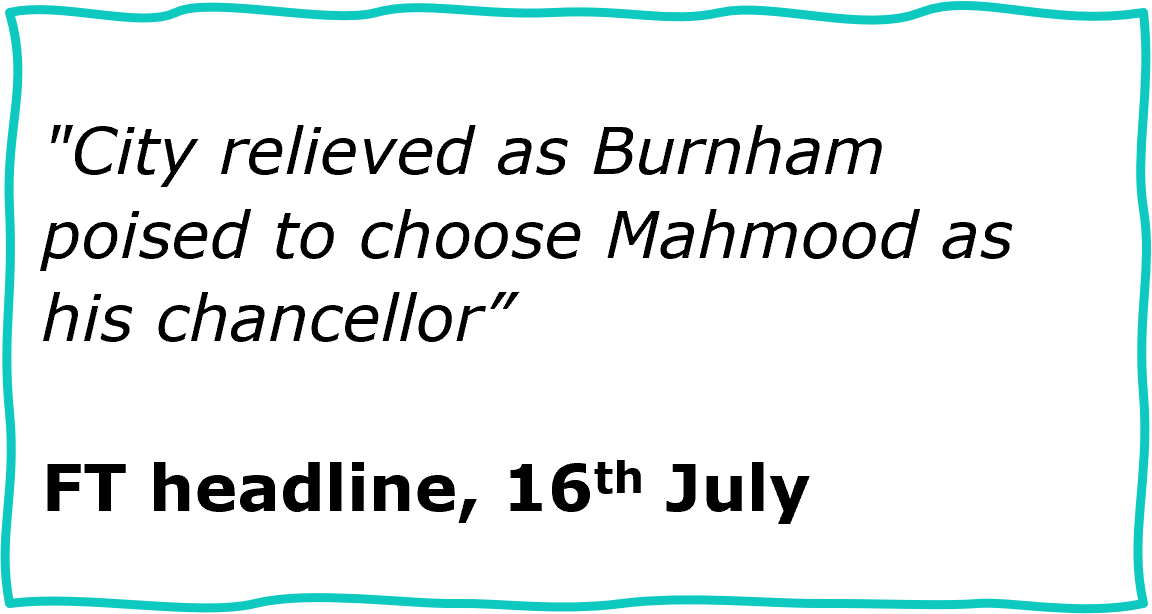
This week the FTSE Small Cap was in the fore, up 1.2%, and closely followed by the FTSE 250, both with a domestic focus. Markets are quietly, but positively, responding to the increasing likelihood of a more pragmatic new Prime Minister and Chancellor. Housebuilders, which have been a dog in 2026, had a notable lift on Wednesday as leaks emerged on the choice of the next Chancellor. Next week the financial markets reaction will be very telling as the new Cabinet is named. We will see if the UK is in the Mahmood for Burnham.
Higher income tax, higher capital gains tax, a mansion tax, and possibly an increase in VAT? The detail will emerge in the Autumn, but the road being travelled to higher taxes is clear, and it is important to understand the investment and tax planning implications, particularly where there is the opportunity to sidestep significant tax changes. We will cover these in a new webinar in two weeks, so keep an eye on your inbox for details.
For now, enjoy the weekend in the sun.