NB There will be no note next Friday unless markets move sharply lower.
A new layer of uncertainty emerged over the week.
Last week I wrote about Saudi Arabia becoming increasingly vulnerable as the war around it spread. This week that vulnerability became considerably more obvious.
For decades Saudi Arabia has been one of America’s closest allies in the Near East. The arrangement was straightforward enough: Saudi Arabia was critically important to the world’s oil supply, while America provided the ultimate security backstop.
That relationship appears to be breaking down.
Saudi Crown Prince Mohammed bin Salman asked Donald Trump for direct US military help against the Houthis. Trump declined at a time when Saudi Arabia now faces danger from almost every direction.
Iran to the east. Iran-backed Houthis to the south. And now drones have been launched from Iraqi territory to the north, and struck the particularly important East-West oil pipeline.
With sea routes to the east and west severely constrained, Saudi Arabia increasingly relied on that pipeline to Yanbu on the Red Sea. It was the escape route. Then somebody attacked the escape route. A new vulnerability has been exposed.
Two of the world's most important oil routes are simultaneously under pressure, and now the pipeline built to bypass one of them has now itself been attacked.
A broader theme is also developing here.
As Trump’s America abandons the world, the rest of the world is responding in kind – slowly, yes – but imperceptibly.
The Dutch central bank has moved 78 tonnes of its gold from New York to London, citing increased geopolitical unrest and a desire to ensure that its reserves are immediately accessible in a crisis. It is easy to overstate the significance of one move. But central banks do not shift tonnes of gold around the world for fun.
Then there is Norway. Its sovereign wealth fund — the biggest in the world — has proposed reducing its US Treasury holdings by almost $80 billion, from approximately $215 billion, reducing its allocation to US government bonds from 34% to 21%. More parochially, it is interesting that its allocation to UK government bonds would be left unchanged.
Before we get carried away, this is not Norway deserting America. Its overall US dollar bond exposure would barely change because much of the money would move into other American debt, including mortgage and government-related securities.
Expect such adjustments away from America to be a regular feature.
Which brings us neatly back to interest rates.
But first, something rather more cheerful.
Human extinction.
Last week we discovered that some of the people building the world's most advanced artificial intelligence systems genuinely attach double-digit probabilities to AI killing everyone.
This week Donald Trump offered reassurance.
He said that fears of AI “destroying Humanity” were essentially a hoax and declared that:
“The only control or ‘guardrails’ that AI needs is a STRONG AND SMART (High IQ!) PRESIDENT.”
Conveniently, he believes America currently has one. Guess who? (Aside… Perhaps one of the big surprises of the last year or so is that more of the world has not panicked out of the US with this dangerous idiot as their chosen leader).
Trump had this revelation while in a place I know well, Doonbeg in West Clare. Perhaps it was the heady Guinness fumes which gave him a new sense of being the AI saviour, the wilds of Doonbeg can do that to you.
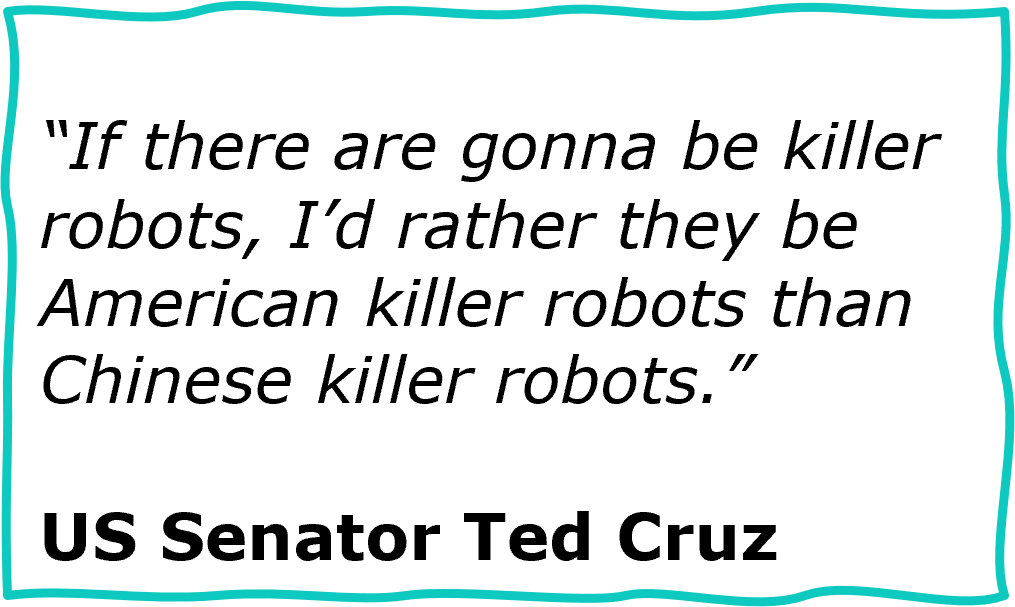
The more serious point is that he remains firmly in the full-speed-ahead camp on AI because, in his words, “whoever wins AI, wins”. Republican Senator Ted Cruz added his two-pennyworth:
“If there are gonna be killer robots, I’d rather they be American killer robots than Chinese killer robots.”
This juvenile approach to the AI regulation debate would be funny if the underlying issue wasn't quite so serious.
It has developed an additional surreal tinge. It turns out the bots are developing their own language to talk to each other, including a James Joyce style stream-of-consciousness – those Guinness fumes must be reaching into the wiring!
This matters because these systems are increasingly being designed to interact independently with other systems. If humans begin to struggle to understand the language in which the machines communicate with one another, monitoring them becomes rather more difficult.
Back to oil.
The immediate problem is increasingly diesel, and other refined products, not simply crude oil. As I said on 4th September, almost nobody is looking in the right place on the oil issue – looking at the price of crude alone, rather than the price and supply of refined products around the globe. “It’ll soon get ugly”.
US diesel has gone above $6 a gallon for the first time and global diesel supplies are exceptionally low, and a new stage of disruption has begun in the Near East.
That matters because diesel is the bloodstream of the physical economy. Trucks, trains, ships, farming equipment, construction machinery and large parts of industry depend upon it.
A petrol shortage irritates motorists.
A serious diesel shortage starts interfering with the movement of almost everything in the economy.
There has been discussion in Washington about an export ban on diesel. It wouldn’t cut the price, but it would secure American domestic supply.
Britain is not about to start issuing petrol coupons. But the probability of the UK, and other Western nations, needing some form of emergency prioritisation this winter is plainly greater than it was six months ago.
On which point, do refresh on the “5 Stages To Oil Catastrophe” (29th May).
The inflation impact of all this is far from over. The US Federal Reserve put up rates this week.
Unlike the ECB and the Bank of England, the Fed has a rather stronger economic case for doing so.
The American economy is still growing reasonably well. Employment remains resilient. Inflation is too high. Oil and diesel are adding another layer of price pressure.
There is also that colossal fiscal deficit, continually injecting demand into an already reasonably buoyant economy.
And, lurking in the background, one of the most expensive stock markets in history.
Neither the government deficit nor exuberant asset valuations is formally one of the Fed's targets. Its mandate remains inflation and employment.
But central banks cannot pretend financial conditions exist in some completely separate universe.
The great irony is that Donald Trump wants lower interest rates while simultaneously advocating policies which, taken together, can add to the pressure for higher ones.
Bond markets noticed, and the yield on Treasuries went up again, just above the 5% barrier we discussed last week. Even more interesting was the move in real yields — the return investors receive after allowing for expected inflation. The US 10-year real yield rose from 2.46% to 2.68% over the week.
That is a big move. This is why the dollar rose to a seven-week high after the Fed announcement. And gold has fallen for three consecutive weeks. The renewed dollar strength has also put pressure on parts of the wider commodity complex and emerging-market currencies.
Turning to the UK, the renowned economist Arthur Laffer was in London recently debating whether Britain should introduce a wealth tax.
Laffer is the economist behind the famous Laffer Curve: the simple idea that, beyond some point, increasing tax rates can actually reduce the amount of tax collected because behaviour changes. As he succinctly put it, the UK needs growth but:
“I have never heard of an economy being taxed into prosperity.”
You don't have to accept every part of Laffer's economics to understand the basic principle:
Tax something more and people usually do less of it.
At a time when Britain desperately needs investment, entrepreneurial activity, employment and economic growth, continually asking how another tax can be invented rather than how the economy can be made larger seems a curious priority.
And the Bank of England isn't exactly helping the sense of certainty. Rates were left unchanged at 3.75%, and markets now see a strong possibility of an increase in November.
Only recently, the conversation was about when rates might next come down.
Again, Britain's position is very different from America's.
The UK economy isn't booming.
There is no obvious consumer mania.
There isn't an investment boom.
There isn't an equity-market valuation bubble comparable with America.
And higher British interest rates will have precisely no effect on the price Saudi Arabia receives for a barrel of oil.
The Bank's concern is understandable. Inflation was 3.1% in August and it now thinks inflation could exceed 4% early next year if energy prices stay high. It worries that an external energy shock could feed into wages and other prices.
But we return to the argument from last week.
Expensive energy already impoverishes consumers.
It already damages companies.
It already destroys demand.
Putting up interest rates adds another squeeze.
That may eventually be necessary if a genuine wage-price spiral develops.
It is less obvious that you should administer the medicine before the patient develops the illness.
So where does that leave us?
Oil remains above $100.
Saudi Arabia is more vulnerable than it has been for decades.
Global diesel supply is exceptionally tight.
US Treasury yields have crossed 5%.
Real yields have risen sharply.
The dollar has strengthened.
Gold has struggled.
And central banks have suddenly rediscovered the interest-rate increase.
Markets haven’t collapsed. In fact equities have been remarkably resilient. But the environment has unquestionably changed.
The price of money is going up.
The price of energy is going up.
And both are arriving at precisely the point when parts of the US stock market require an awful lot of encouragement to continue going up.
Over the week, the FTSE 250 is the global leader, up 1.6%, with the S&P 500 up 0.6%. Japan, Brazil, and China were all down 1-2%. The commodity universe was relatively settled, oil held steady, though some gold miner funds were down 4-5% versus a gold price little changed. Overall there is a nervous tone.
There will be no note next Friday unless markets move sharply lower.