Over the week, if you exclude the US, it was another week of drift across major world markets, with China and France the worst of the bunch, down 2-4%. The UK was down less than 1%, in spite of a lack of any government strategies for growth and a new Chancellor who is a tad invisible.
It is the US stock market which deserves a closer look. Our reference point is usually the S&P 500 index – made up of the biggest stock market-quoted companies in the US. The Russell 3000, as the name suggests, has much greater breadth, in particular including smaller companies – so it is very representative of US trends.
At the moment, nearly 57% of those companies are more than 20% below their highs of the last year. By common definition, this means that more than half of those populating this measure of corporate health are in bear markets. More than a quarter of those 3000 companies are more than 25% below their 52-week high.
The Nasdaq Composite is another measure of 3000 US companies, but in this case much more heavily tilted to the technology sector. Nearly 50% of these constituents are down more than 40%.
This is not healthy.
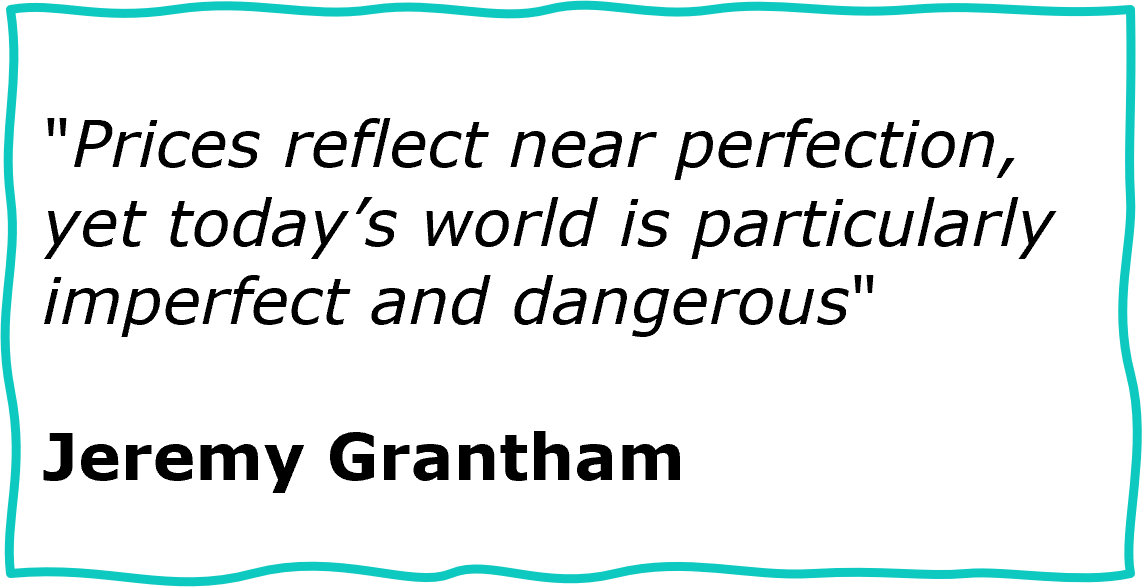
More worrying still is that the S&P 500 was driven to a new all-time high this week by just four mega companies, Microsoft, Nvidia, Apple and Meta. This very narrow leadership makes the US market extremely vulnerable to AI disappointment in the short term, AI being the primary driver of three of the four winners (Apple is the sole exception).
There are some uncomfortable historical echoes. Similar combinations of stretched valuations, weakening market breadth and increasingly narrow leadership appeared around major market peaks in 1929, 1961, 1972/73, 2000 and 2007. The subsequent falls were respectively about 89%, 28%, 48%, 49% and 57%.
This is no guarantee on what happens next. But neither is it something you and I can casually ignore.
And note that in 2000, when the S&P fell 49%; the technology-heavy Nasdaq fell 78%.
These cracks didn’t catch the headlines in the UK over the week, but riots across France did.
In 2012 I said in relation to increasingly indebted governments that “the authorities can buy time. But if they don’t come up with solutions, eventually the electorate will take charge”. Since 2012 disgruntled voters and taxpayers have increasingly expressed their ire. In 2012 it was the euro crisis which prompted that comment (though it applied equally across the developed world), and that crisis is being resurrected, this time at the very heart of the European experiment – France.
Experiment? Yes it remains an experiment. History provides no comfortable template showing that a monetary union can endure indefinitely when control of the money sits in one place and control of the spending and borrowing sits in twenty different sovereign states.
Take France. If investors start to worry it has borrowed too much, they demand a higher return to hold its bonds. Yields rise, borrowing gets more expensive, and the worry feeds on itself.
If this were Britain, the Bank of England could, in an emergency, buy huge quantities of gilts and create the pounds needed to do so. That does not make the debt disappear, and it might create other problems, but Britain cannot literally run out of pounds.
France can’t do that. It cannot tell the Banque de France to create euros and buy whatever amount of French debt is needed. That decision belongs to the ECB which has to consider the whole euro area, not just France.
So France controls its own spending and borrowing, but not the currency behind it, while the ECB controls the currency, but not France’s budget.
That is the awkward flaw at the heart of the euro.
In normal times you can paper over that contradiction with rules. In a crisis it becomes much more uncomfortable.
In the end there are only two clean ways to resolve the contradiction. Europe can move backwards, break up some or all of the eurozone, and national governments revert to a sovereign currency. Economically, that could be chaotic in the short term.
Or it can move forwards and give the EU much greater control over borrowing and budgets within individual countries. Politically, that could be dynamite for years. It would require a degree of political union across Europe which many voters in individual nations are reluctant to accept, and increasingly so right at the centre of the EU – France and Germany.
Everything in between is, to some extent, an attempt to manage the contradiction rather than remove it.
This is a tough one for Europe.
There are four Dynamic portfolio reviews this month.
The Bonkers 3 Month Portfolio reminds us that this is highly volatile – down nearly 10% in the period against the index which is up a little, and also poor over 5 years. Yet it is up 5,601% since inception in 1999, more than 6x FTSE World. Not for the faint-hearted.
Of more practical value, one of my long term favourites is up for review, Dynamic UK Smaller. Up 19% over 6 months, a touch better than the index, and it has grown 2,527% since inception in 1999, more than 5x the index.
It’s also time for “What’s Hot, What’s Not?” for the calendar month. Tech funds have a clean sweep, and also dominate the sector analysis. Commodities struggled, brought down by gold and oil particularly, though that could swing around in a day. India and China disappointed – we keep a close eye on both for opportunities.
I will be trekking somewhere between India and China for the next couple of weeks, and you will be in the capable hands of Joe and Ruairi.
I would also like to congratulate the Dennehy Wealth team for being named as one of the Top 100 Financial Advisers in the UK for a second year running, out of 5,500 UK firms. A great achievement.
For now from me, tashi delek.