John Healey's first Budget was about as dull as we expected it to be.
That is not necessarily criticism. After several years in which investors have become accustomed to governments fiddling with tax rules, some stability is welcome. Healey resisted another broad increase in the headline rates of Capital Gains Tax (CGT). There were changes around the edges - notably a reduction in the lifetime limit for Business Asset Disposal Relief - but nothing resembling another wholesale assault on investors and business owners.
That at least suggests an understanding that there is a limit to how far the government can keep pushing tax before it starts changing behaviour, discouraging investment and demoralising the people expected to create the wealth in the first place.
Two fundamental UK problems remain. The government still spends too much relative to what it can sustainably raise in taxes, and Britain requires much stronger economic growth to help get debt lower. Many of the harder decisions on welfare and longer-term spending have effectively been pushed into next year's Spending Review.
In other words, this Budget has bought some calm. But it has not yet answered the deeper question: how do we make government affordable while making the economy grow faster?
From a financial-planning perspective, Dennehy Wealth has produced a short guide to the Budget, together with actions which can be taken now to mitigate some of the tax changes already in the pipeline. It also includes a timeline showing when the various changes take effect. Take a look here.
Markets were largely unperturbed. Gilts and sterling took the Budget in their stride and UK shares were little changed. Global investors have bigger fish to fry - in America, where the midterm elections are only days away and the AI trade is being tested more seriously, and in France, where the strain of government spending excess is showing most clearly in the bond market.
France is increasingly looking like an emerging market in one vital respect - it has borrowed enormous amounts in a currency which its national government cannot create.
France decides how much it taxes, spends and borrows. But if investors lose confidence and French bond yields surge, Paris cannot simply tell the Banque de France to create euros and buy whatever quantity of French debt is required. That power sits with the European Central Bank, which has to think about the whole euro area, and on this issue Germany will be particularly tetchy. The easy answer of simply taxing more is becoming progressively less credible, politically and economically. But so is the possibility of cuts in expenditure, certainly politically.
Their bond market has noticed this impasse. French 10-year borrowing costs have recently been close to 24-year highs, and the extra yield investors demand over German bonds has reached levels not seen since the euro debt crisis in 2011.
Britain is not France. Tax and spending burdens are materially lower, and - crucially - Britain still controls sterling and has its own central bank. But France is a useful warning of where a country can end up if a welfare state grows faster than the wealth-generating economy required to sustain it.
France needs to decide what welfare system it can afford, and then how to generate the wealth needed to pay for it. Britain ultimately faces the same question. This week's Budget did not settle it.
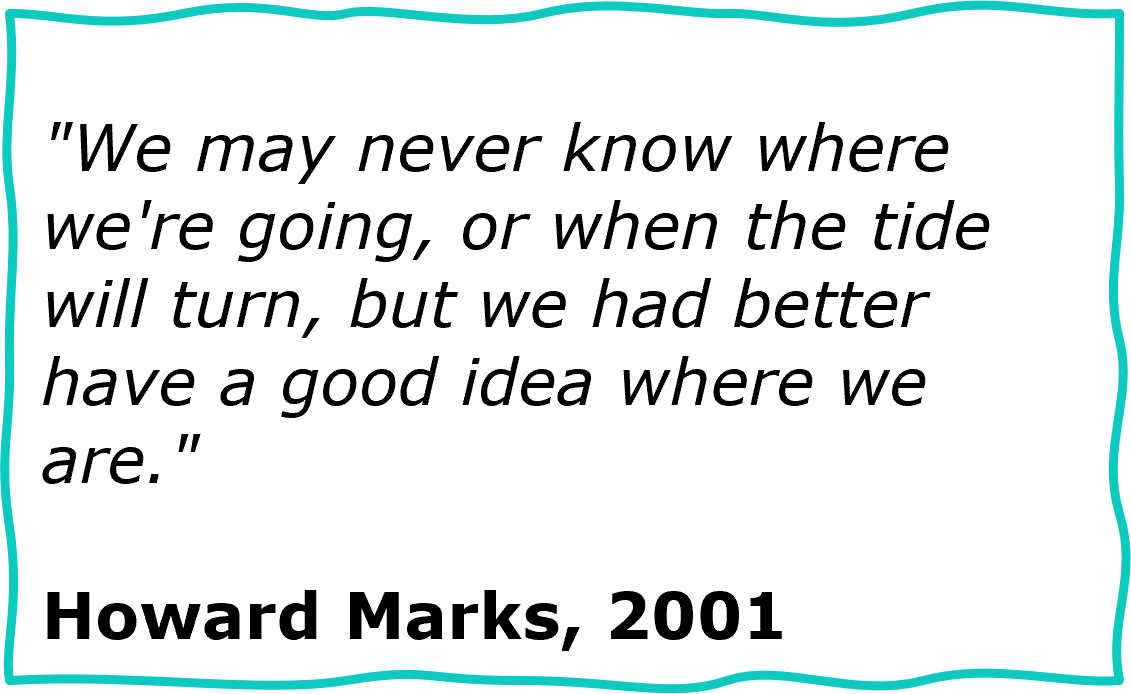
Which brings us back to Howard Marks.
I often say that we cannot predict markets, so we must prepare. Marks put it more elegantly: we may never know precisely where we are going, or when the tide will turn, but we had better have a good idea where we are.
We do not know when this investment cycle will end. But we do have a range of useful indicators which tell us something about where we are within it and that is where sensible risk management begins.
At this stage, the message is straightforward: keep expectations sensible and defences high.
Another way of locating ourselves is simply to compare this bull market with history. On Ned Davis Research's measure, the current bull had already gained roughly 108% over about 1,000 market days, compared with an average bull-market gain of about 81% over 558 days. That tells us nothing about when the bull ends. It simply tells us that we are no longer in the young, easy part of the cycle.
One of the clearest warning lights remains the extraordinary lack of breadth in the US stock market. In late September, with the S&P 500 still close to record highs, around 60% of S&P 500 companies were more than 20% below their own highs. A 20% fall is the conventional definition of a bear market. The generals - the giant technology companies - were still advancing, but an extraordinary number of troops had stopped following.
This is not a crash signal. But the manic headlines give a much healthier impression than the underlying reality.
An old-fashioned valuation chart gives another sense of scale. At the end of August the S&P 500 was on roughly 7.9 times book value with a dividend yield of just over 1%. The index would have to fall by something approaching 85% merely to return those two measures to the old historical range in which they spent much of the period from 1927 to the late 1980s. That is not a forecast, but it does show just how far today's valuation has travelled from what used to be called normal.
The small number of companies leading the S&P (and other global markets such as Korea) are dependent on one enormous theme: artificial intelligence.
Our own experience of AI remains breathtaking. The technology is real. The improvement in capability is real. The potential productivity gains are real. I have no difficulty believing that AI will eventually transform large parts of the economy.
The much harder question is financial: who will make enough money, soon enough, to justify the astonishing amount being spent today?
The AI build-out is becoming one of the largest capital-spending programmes in history. Data centres, chips, electricity generation, grid connections, cooling systems and networking infrastructure all have to be paid for before the hoped-for productivity benefits arrive at scale.
For a while, much of this could be financed from the enormous cash flows of the largest technology companies. Now the money is having to be borrowed, in the bond market, and that market is asking hard questions.
The cost of insuring against default by a number of AI-linked companies has risen sharply. Default insurance on Meta and Nvidia recently reached record highs; Oracle's has risen much further; and CoreWeave's debt has traded at levels usually associated with real financial distress.
This does not mean Microsoft, Meta or Nvidia are about to default on their bonds. But it does mean that lenders are no longer treating the AI build-out as a free financial lunch.
There is another constraint emerging outside financial markets. Opposition to data-centre construction is becoming a genuine political issue in America. Voters in ten states will consider measures next week which could delay, restrict or impose new requirements on data centres. Concerns range from electricity bills and water use to the sheer scale of the developments.
Again, none of this stops AI, but delays cost money, and so do regulation and higher borrowing. And all of them push the eventual payback from today's extraordinary investment further into the future.
This is where the competition for capital becomes important. AI companies want enormous amounts of it. Governments, especially the US government, also want enormous amounts of it. Ordinary businesses still need to borrow too. When more borrowers compete for the same pool of savings, the price of money tends to rise. We can already see that in government and corporate bond yields hovering around levels which would have seemed extraordinary only a few years ago.
The easy phase of the AI trade is probably behind us. The winners may continue winning, and there may be enormous profits still to come. But the vulnerability was amply illustrated yesterday as the shares of Google parent Alphabet, the third largest quoted company in the US and the world, fell 13% in minutes.
The market is increasingly asking the right second question: not “is AI amazing?” but “will the economics justify what we are paying for shares in AI businesses?”
That question is especially important because US economic strength has enjoyed two unusually powerful supports: enormous government deficits and an extraordinary AI investment boom. If either support weakened materially, an important source of US growth, and “exceptionalism” would disappear.
Governments have little room for manoeuvre, particularly when elections are close. AI companies also have limited freedom to retreat. The competitive logic is brutal: each fears that if it slows down, a rival will spend more, build faster and take the prize. They have, in effect, placed an enormous bet on red and are now reluctant to leave the table.
If I had to sketch one possible path from here (not a prediction, just an over-active imagination!) it would be a sharp market setback which finally breaks some of the speculative excess, followed by emergency interest-rate cuts as growth slows. Lower rates could then create the conditions for the next economic upswing, while the genuine productivity benefits of AI gradually begin to show through. Beautiful solutions often have ugly parents.
But we should not pretend to know that this is what will happen.
It has never been possible to predict financial markets with useful precision and consistency. Yet we increasingly live in an age which is profoundly uncomfortable with not knowing. Technology appears to promise an answer to everything, and we can easily mistake having more information - or partial knowledge - for genuine understanding.
Understanding often requires patience. Sometimes the intelligent answer is simply “I do not know”.
Keep participating where the opportunities remain attractive. But keep your expectations sensible, know where you are, and importantly, keep the defence a little higher.
Over the last week the bulk of mainstream stock market indices have gained 1-2.5%, and Autumn is unseasonably steady. Looking over the month, as it’s time for our “What’s Hot, What’s Not” feature, there are encouraging signs of life from UK funds, though it remains a narrow sample. Korea caused the most damage to the dud funds. Amongst sectors, the Biotech bounce is very interesting, coupled with decent UK equity progress. China, Korea and Brazil caused the most damage amongst the dud sectors, with falls of around 7%.
The next week or so promises to be interesting. Take care.